Thursday, February 4, 2016

Goulet Park


Elzéar Goulet Memorial Park
Commemorates Prominent Métis
Monuments and plaques commemorating Elzéar Goulet (1836–1870) were unveiled during the summer of 2008 in the park on Taché Avenue that bears his name. Goulet was part of a prominent Métis family. As a young man, he relocated to Pembina in what is now North Dakota and became an American citizen. There he began to raise a family with his wife, Héléne Jerome. Goulet was appointed in 1861 to replace his brother Roger as the mail carrier between Pembina and the Red River Settlement. Whether by horse in the summer or dog sled in the winter his weekly trips between the two settlements made him well known and respected.

Goulet was a military leader with Louis Riel’s provisional government in 1870. He was involved in the conviction of Thomas Scott who was executed for treason by the provisional government. For his part in the execution, Goulet on 13 September 1870 was chased by an angry mob on the streets of Winnipeg in broad daylight and pelted with rocks from the shore and he drowned as he attempted to swim across the Red River to St. Boniface not far from the memorial site. Investigation of his murder identified the principal perpetrators but charges were never laid for fear that attempted prosecutions would be unenforceable. Goulet was buried in his family plot under a simple tombstone in the St. Boniface Cathedral Cemetery.

Wednesday, August 26, 2015

Grandfather of Andre Jerome -- Jean-Baptiste Letendre


LETENDRE, dit Batoche, JEAN-BAPTISTE (also known as Okimawaskawikinam), fur trader and farmer; b. 30 Aug. 1762 in Sorel (Que.), son of Jean-Baptiste Letendre (1736–1809) and Marie-Madeleine Cardin, dit Loiseau (1742–1808); m. c. 1785 à la façon du pays Josephte “Crise,” a member of the Cree nation, in the northwest; d. in or after 1827, probably in St Boniface (Man.).
Jean-Baptiste Letendre, dit Batoche, came to the northwest in the 1780s. In 1785–86 he was employed by the North West Company in the Athabasca department as a “devant” or bowsman. He is listed as an interpreter in the region of Fort des Prairies (Fort-à-la-Corne, Sask.) in 1804. Marie-Anne Gaboury* and Jean-Baptiste Lagimonière*, who spent some time in the area in 1808, are reported to have met the Canadian Batoche and his Cree family. In 1810 Letendre or his son, who was also called Jean-Baptiste, was with the explorer David Thompson*. In his diary Thompson mentions that Letendre and his family arrived from the region near Beaverhill Lake (Alta), bringing a hundred or so beaver pelts. That year Letendre or his son went with Thompson to explore the Athabasca River as far as the Rockies but quit the expedition in January 1811 at the camp on the Canoe River (B.C.), a tributary of the Columbia.
In the 1810s and 1820s it appears that Letendre engaged in the fur trade on his own account as a “freeman,” to use an expression common in the northwest. Alone or with his family he owned a trading post called Batoche at Muskootao Point, west of Fort-à-la-Corne on the north bank of the Saskatchewan. The Letendres also stayed for a time in the Red River colony (Man.) during this period. On 19 June 1816 one of their sons was killed in the engagement at Seven Oaks (Winnipeg), known in historical writings by the Métis and French of the west as La Grenouillère [see Cuthbert Grant*; Robert Semple*]. The NWC agreed to pay Mme Letendre compensation for this unfortunate accident because of the “good character her husband always bore.”
Around 1825 the Letendres came from Rocky Mountain House (Alta), known by francophones as “poste de la montagne de Roches,” to settle at St Boniface. On 6 June of that year Letendre’s sons Jean-Baptiste and Louis (Louison) and his daughters Josephte and Angélique were married in religious ceremonies. In 1827 Letendre, his wife, and eight children were living on lot 906. Two of their sons occupied land near by with their families. Letendre was a well-to-do farmer, but he was keeping a family of 40. He owned seven horses, a herd of cattle, a canoe, and two carts. It is worth noting that he was farming 50 acres at a time when even the Catholic mission only cultivated 25.
No trace of Letendre has been found after 1827. He is not listed as head of a household or owner of a lot in the 1828 census, or in those that followed. His son Jean-Baptiste settled at Pembina (N.Dak.) around 1850. As for Louis, he made regular trips to the Fourche des Gros Ventres (as the South Saskatchewan River was known) and the post called La Montée on the North Saskatchewan. In 1849 he was one of the Métis who protested against the HBC’s fur-trade monopoly, at the time of the Sayer affair [see Pierre-Guillaume Sayer*]. The Letendre family carried on business both on its own account and for the HBC in the area around Fort Canton (Sask.) in the 1850s and 1860s and settled permanently in that region around 1870. In 1872 Jean-Baptiste’s grandson François-Xavier founded the village of Batoche on the South Saskatchewan River. It was Batoche that became the centre of Métis resistance in 1885 and the Métis capital of the northwest.

Diane Paulette Payment, “LETENDRE, Batoche, JEAN-BAPTISTE,” in Dictionary of Canadian Biography, vol. 6, University of Toronto/Université Laval, 2003–, accessed April 12, 2014, http://www.biographi.ca/en/bio/letendre_jean_baptiste_6E.html.

"dit" Names, etc.

"dit" Names etc.

by
Rita Elise Plourde

* There are two reasons why there are so many variant spellings of some names.
* First: most of the citizens of the 1600-1800 were illiterate. Of these, a precious few could sign their names. However, the priests,seminarians,missionaries, monks & nuns were the most educated groups in the citizenry. Only an elite few were educated beyond what we, today, would consider a basic elementary education.
* Consequently, many of the clerics & notories, who under the French system of administration were charged with recording "vital statistics" wrote the names as they knew them to be in France, as a precious few of the immigrants/colonists signed them, or as they heard them (phonetically).
* That is why one sees Garau, Garrault, Gareau,Garo, etc... even amongst the sons of a particualr ancestor. A good example are the descendants of Louis Houde...some of the variant spellings found are: Houd,Houle, Ould,Houde,Hood,etc.
* The second reason for variant spellings is: As the colonists migrated within Nouvelle France/New France & eventually beyond the areas of French-speaking Canada ( ex. to current-day USA, the Caribbean, the West Indies, etc.) recorders of "vital statistics" who were not French speakers, usually spelled names phonetically, or changed them because they didn't have a clue how to write them.
(Ex. Rochefort became Rushfort in the Carolinas, Champagne became Shampang, Thibodeaux became Thibodo, or Tibodo. LeBrun was changed to Brown & Leblanc to White, etc.etc.)
* The "dit" names have an interesting origin. The English translation of "dit" is "said". The Colonists of Nouvelle France added "dit" names as distinguishers. A settler might have wanted to differentiate their family from their siblings by taking a "dit" name that described the locale to which they had relocated ( ex: since the Colonists followed the customs of the French feudal system, land was divided amongst the first born sons [primogeniture] . Soon there was not enough land to divide any further.
* Perhaps an adventurous younger son would decide to establish himself, with or without a family, in another area... say a fertile piece of land near some streams... he might add des ruisseaux (streams/creeks/rivulets) to distinguish himself from his brothers. When he married,or died, his name might be listed as Houde dit DesRuisseaux, or Desruisseau(s).
* The acquiring of a "dit" name might also be the result of a casual adoption, whereby the person wanted to honor the family who had raised them. Another reason was also to distinguish themselves by taking as a "dit" name the town or village in France from which they originated... ex: Huret dit Rochefort.
Rita Elise Plourde (10) is a member of AFGS and contributer of cultural, or historical comments in response to the queries posed by volunteers in the AFGS Volunteers mailing list. She is a bilingually educated ( K thru college) Franco-American anthropologist, who was raised in a multicultural environment. Rita continues to explore, examine &extol the culture of her French/Acadian/Quebecois ancestors & contemporary relatives. Her primary aim as an AFGS member is the sharing of information & research regarding her French/Acadian/Quebecois ancestors, their culture & their legacy.


(Source: American-French Genealogical Society
Surnames French-Canadian : Variants, Dit, Anglicization, etc.
http://homepages.rootsweb.ancestry.com/~afgs/index1.html)


* * * * * * * * * * * * * * * * * * * * * *

Some examples of dit names used in conjunction with the Jerome surname:

Jerome - Latour
Jérome - Beaume
Jérome - Beaumeleblanc
Jérome - De la Tour
Jérome - Latour
Jérome - Leblanc
Jérome - Longtin
Jérome - Patry
Jérome - Rivière
Jéróme - Hélie
Jérôme - Baumeleblanc
Jérôme - Beaume
Jérôme - Delatour
Jérôme - Lonquetin
Jérôme - Patry
Jérôme - Rivière

Sunday, February 2, 2014

Memorable Manitobans: Martin Jerome (1849-1936)

Click to enlargeFarmer, municipal official, immigration agent, MLA (1888-1892), MLA (1892-1895), MLA (1900-1903).
Born at Pembina, North Dakota on 23 November 1849, one of thirteen children of American parents, he was educated at St. Boniface and, in 1870, he married to Leocadie Carrierre. They settled on a farm in the Parish of St. Pierre, south of Winnipeg. He was the first Reeve of the Rural Municipality of DeSalaberry and was later elected to the Manitoba Legislature for the Carillon constituency, serving until 1903. He assisted in organizing the first Manitoba Liberal Association, along with Daniel McMillan and James Fisher, and he served as a federal immigration agent in France and Belgium for several years, and a homestead and forest inspector. He was a vigorous supporter of separate Catholic schools. He died at St. Boniface, Manitoba on 22 July 1936 and was buried in St. Norbert Cemetery

Tuesday, November 5, 2013

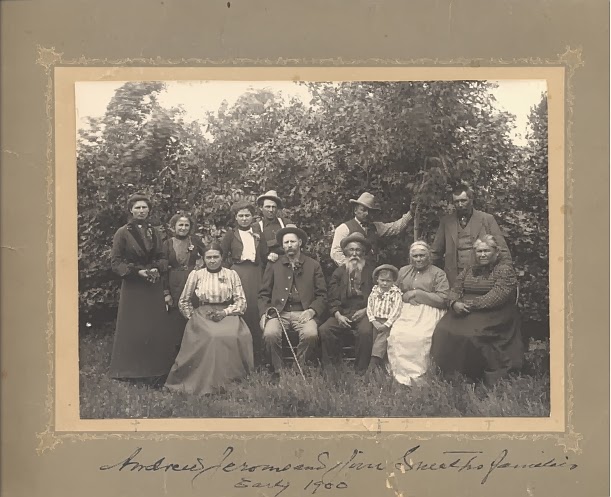
Photo: Andrew Jerome and Jim Smith Families (Early 1900)

A kind lady contacted me about a picture she found in a California antique mall.  Fortunately, she found my website about the Jerome Family and offered me the picture at her cost in order to get it back to the family.  The photo is in excellent condition.  What a find.  Judging by the size of my Uncle Julius (boy in the picture), I believe the picture was taken about 1904-5 near Hallock MN.  Annotations on the back of the picture, made by a descendant of Jim Smith and Andre Jerome, are included without any editing.


Elizabeth Smith Burk (mom's sister)
Anna Smith Irwin (Mother) 14 yrs.
Angeline Jerome Pearenteau (mom's aunt)
Marie (Mae) Smith (Panshab, Whiteside ) (Mom's sister)
Roger Jerome (mom's uncle)
James H Smith (mom's father) ((Hiram – Elizabeth Smith) mom's grandparents)
Martin Jerome (mom's uncle)
Andre Jerome (mom's grandfather) ( his bro. Was married to Napoleon Bonaparte's sister)
Julius Jerome (Napoleon's son)
Margaret Goslau Jerome (mom's grandmother) (Her mother McKay, King
Napoleon Jerome (mom's uncle) (his wife was Elizabeth Renville)
Margaret Jerome Smith (Mrs. James Smith) (mom's mother)

Not on here
Margaret Jerome
John Jerome oldest
Alexander
Andrew
Martin
Napoleon
Roger
Julian (died at 6 yrs)
Sam
Angeline
 
(This last group of names are the children of Napoleon Jerome.)

Thursday, September 8, 2011

First Bible in Minnesota


An article appeared in a Winona MN newspaper during the Minnesota Centennial crediting Joseph Renville, my 3d great grandfather, with introducing the first Bible into Minnesota in the early 1820s.  It is said he imported the book from France.  While he could not read the book, he spoke fluent French as well as his native Dakotah language (language of the Sioux).  At the mission he established at Lac Qui Parle, the missionaries would read the book to him in French and he would repeat their words in the Dakotah language.  It was in this way that the Bible was first translated into the language of the Sioux.  The story goes that it took several years to complete the translation of all the books of the Bible.  Additionally, Joseph Renville translated several hymns popular at that time into the language of the Sioux and is credited with writing several hymns himself.  It is unfortunate that an accident at the mission caused a fire which destroyed that first Minnesota Bible.

The mission established by Joseph Renville at his fur trading post can be visited in Lac Qui Parle State Park near Montevideo, Minnesota.  Although the stockade and buildings of the fur trading post are no longer there, an historic marker marks the spot where it was placed next to the lake.

Thursday, April 28, 2011

Joe Rolette


Most everyone who has read about Minnesota history has seen a story about how Joe Rolette was responsible for the state capital remaining in St. Paul when Minnesota became a state. Usually, the story tells about this jolly half-breed from Pembina who stole the bill when the territorial legislature passed it and held it hostage until it could no longer be signed to make it law. This simple telling of the story is misleading about the actual facts of that incident in our history, largely because of differing political reasons for telling it in that way.

Lost in the short explanations is the description of the racial demographics of that time and place. Pembina County, represented by Joe Rolette, had a population majority which was made up of people involved in the fur trade. These were mostly Indian or mixed blood French-Indian people, often called Metis. The same was true of much of the Northern part of the territory. A major discussion among politicians of the day involved around questions about who should be allowed to vote, with European settlers doubting that those non-whites were civilized enough to be allowed to participate in elections.

Joe Rolette was a well educated, wealthy, young man who came from Wisconsin to Pembina to open a fur trading post. He was a generous and well-liked person in that community. Although not a Metis himself, his ties to that group were largely derived from his marriage to Angelique Jerome, sister of Andre Jerome, who was of mixed Cree Indian and French ancestry. He championed the cause of these people and represented them well in the territorial legislature. Together they raised eleven children.

A number of legislators preferred the future state of Minnesota should have its northern border much further South than where it ended up and to have its capital near the center of that area in St. Peter. They arranged speculative land purchases there in order to obtain some benefits from the relocation of the state capital. The governor, who wanted to sign the bill, was among those speculators who would benefit. However, the state borders ended up quite differently, but the bill to move the capital was passed. In his role as the legislative committee chairman who was charged with the responsibility to certify the validity of the bill which had to be signed, Joe Rolette legally had the bill in his possession. Some historians believe there were technical problems with the writing of the bill. Others claim that Rolette simply did not believe it wise to move the capital from its St. Paul location. Whatever the reason, he withheld the bill from being presented for signature until past the deadline to make it law.

This action by Rolette made him a hero to the people in St. Paul. A prominant artist of the day painted a portait of Rolette in typical Metis dress which was hung in the State Capital for many years. This portrayal provides some emphasis for the well-circulated but misleading story of this famous incident. Historians have written about how this well-educated, wealthy trader would present himself to the St. Paul society in expensive tailored clothing obtained when he was in St. Paul on business. It should be noted that Joe Rolette was involved with Norman Kittson in establishing the train of Red River carts that provided the transportation of the fur trade products from the Red River Valley of the North to the growing business center at St. Paul. That transportation system ended with the building of the Great Northern Railway.

An interesting fact of North Dakota history is that Joe Rolette was the first person to file a homestead in North Dakota for property at Pembina. He made the first transfer of property by deed in North Dakota to James J. Hill, builder of the Great Northern Railway, for the purpose of building warehouses. He also donated the property on which the Assumption Catholic Church was built in Pembina.

Some of this background is described in an article published by the Minnesota Historical Society in The Power of Whiteness; Bruce M. White.

Monday, March 22, 2010

Jerome Family Group -- Join Us

A Jerome Family group has been established as a networking tool for descendants of Andre Jerome at the Kittson County Historical Society's site. It is appropriate for it to be located there because of the importance of that family to the history of Kittson County, Minnesota. All Jeromes and their descendants are invited to join and participate in the commentary between 'cousins'. The Jerome Family page can be reached at http://kittsonhistorian.ning.com/group/jeromefamily. There are 14 members who now contribute to the conversations.

Wednesday, August 5, 2009

William Hemmings Cook, 1766 - 1846

William Hemmings Cook(1) was my gr-gr-gr-grandfather, on the family side we normally think of as the French side. However, he was from England, an officer of the Hudson Bay Company and later one of the patriarchs of the Red River Settlement (the area now Winnipeg). My grandmother, Eliza Renville Jerome was his granddaughter.

When the Hudson Bay Company established their trading posts, they had a rule that their employees should not be married. That was probably to help keep their expenses down. But the officers of the posts disregarded the rule and eventually so did the lower level workers.

One report says: "Prominent HBC officers who practiced polygamy included James Isham, Joseph Isbister, Robert Pilgrim, Moses Norton, Matthew Cocking, and William Hemmings Cook."(2)

He had at least three wives, perhaps four, according to records in the Hudson Bay Archives and other historical documents. It appears that his wives were Cree or Assiniboine Indian women.

The practice of polygamy began to decline as the 1800s neared, and following the merger of the Hudson Bay company and the North West Company marriage contracts became the general rule.

I found it interesting to note that among the family and descendants of William Hemmings Cook are a number of people who were prominent in the work of the Anglican church in Manitoba. His granddaughter, Sarah Sally Cook was the wife of James Settee, the second native ordained as an Anglican priest. She had two brothers in the ministry and another a missionary teacher. This was during a period when there was unusual growth in the acceptance of the faith in that area.

This is just part of his story.

(1) COOK, WILLIAM HEMMINGS, fur trader, settler, and politician


(2)Femmes du Pays: Women of the Fur Trade, 1774-1821, by A. Gottfred

Sunday, February 22, 2009

Jean Francois Jerome Beaume Leblanc Latour

(Capitaine de la Compagnie de Sieur Du Francois Verrier)

(Francois Jerome arrived in Quebec from France about 1698. He was the first of our Jerome family ancestors to arrive in North America. This article, received from Sarrah Brown, explains that he was also known as Jean Francois Jerome Beaume Leblanc Latour and is also an ancestor common to families who use the surname Latour.)

Jean Francois Jerome Beaume Leblanc Latour was born about 1675 at St. Pierre, Medreac, St.-Malo, Bretagne (Brittany), France. the son of Jean Jerome Beaume Leblanc (b. 1650) and Jeanne Bougau (b. abt 1655). The parents of Jean Francois were also born at that ancient Brittany village.

The exact date of Jean Francois’ arrival in New France is not known at this time. Unlike our Cote, Lefebvre and Gagnon ancestors however, it is known that he arrived as a soldier in the Le Verrier French Regiment probably about 1695. Jean Francois first appears in Quebec parish church records as a witness at the wedding of fellow soldier, Noel Legault Deslauriers, on November 18, 1698 at Montreal. His occupation on the document is listed as: Soldat de la Compagnie, De m. Le Verrier. On March 14, 1701, Jean Francois is again a witness to the wedding of a fellow soldier, Jacques Theoret Lariviere, at Lachine Quebec. The Governor General of New France also attended and was a witness to this marriage as was the Commanding Officer of Francois’ regiment, Francois Leverrier. Between 1703 and 1705, Jean Francois is godfather and/or witness at three baptisms at Montreal. His Commanding Officer, Francois Leverrier, had been, in France, a Musketeer in service to the King of France prior to his being dispatched to New France as Commander of a Compagnie of Soldiers and still in the service of the King of France.

At the age of thirty, Jean Francois himself was married at Notre Dame, Montreal, on the 3rd day of November, 1705. His bride, Marie Angelique Dardenne was born the 19th of May, 1682 at Repentigny, Quebec, the daughter of Rene De’Ardeyne (Abt 1630-1710) and Marie Francoise Barbery (Abt 1650 – 1725). Present at the ceremony were several “Marchand, Bourgeois” (fur traders/merchants) as well as several of Jean Francois’ fellow soldiers of the “Compagnie de Sieur Du Verrier”. The bride’s father, Rene Dardenne and her brother Toussaint were also present.

Marie Angelique’s birthplace of Repentigny, at that time, was a tiny off-island agricultural community north of Montreal. La Rochelle, France, the birthplace of Marie Angelique’s father, was a seaport of Western France, on the Bay of Biscay. Marie’s mother was born at St. Germain, Paris.

By 1704, Jean Francois was Sergent dans les Troupes de la compagnie de Francois LeVerrier. The parents of Francois’ wife, Marie Angelique Dardenne, considering the tiny farming community where their daughter was born, may have arrived in New France as peasants. However, both Jean Francois as well as his wife Angelique were literate as they were “declared being able to sign” on their marriage certificate which casts considerable doubt on Angelique’s parents arriving in New France as peasants.

Following their marriage, Francois and Marie Angelique made their home in Montreal and the first eight of their twelve children were born at that city. Commencing about 1721, the remaining four children were born at St. Laurent. At some point following his marriage, Jean Francois was promoted to Capitaine in his regiment.

Jean Francois died at the age of eighty on April 19, 1744 at St. Laurent. Marie Angelique died on May 19, 1745 also at St. Laurent, just thirteen months following the death of her husband.

Children of Jean Francois Jerome Beaume Leblanc Latour
and Marie Angelique Dardenne

Francois Jerome born August 26, 1706 at Montreal. Francois married Marie Deniau Ditailly, daughter of Denau Ditailly and Marie Jean Adhemar St. Martin on October 12, 1733 at Montreal PQ. They had eight children at least three of whom died in infancy or in early childhood. During the French Regime, Francois was the earliest voyageur and trader from Quebec in the North West. He also traded under the British Regime. I believe it was Francois’ direct descendent Andrei Jerome who was arrested and tried following the infamous Finian Raid at the Hudson Bay Company Post at Red River in 1871 (see “Manitoba Raid” below).

Marie Angelique (twin sister to Charles) was born April 16, 1708 at Montreal; she died May 8, 1708.

Charles (twin brother to Marie Angelique) was born April 16, 1708 at Montreal; he died on June 21, 1709.

Marie Anne Angelique was born November 29, 1710 at Montreal. On November 7, 1729 at St. Laurent, Marie Anne married Paul Rapideau Lamer, the son of Jean Baptiste Rapideau dit Lamer and Francoise Fluery. they had fourteen children many of whom died in infancy or childhood; Marie Anne died December 28, 1786.

Nicolas Charles was born August 30, 1712 at Montreal. On January 11, 1740 at St. Laurent, Nicholas married Marie Jeanne Aubry Tecle Corneille, the daughter of Francois Aubry Tecle Corneille and Marie Jeannie Bouteilier Tetu. There is a record of them having one son, Francois Amable, who survived childhood and married; they also had a daughter, Marie Jeanne Josephe, whose fate is unknown. Nicolas died at forty-three years of age, on April 25, 1755 at St. Laurent.

Marie Susanne was born May 23, 1714 at Montreal. On January 3, 1738 at St. Laurent, Marie married Jean Blenier Jarry. They had ten children, many of whom died in infancy or childhood.

Marie Anne was born April 5, 1716 at Montreal. Marie died on June 9, 1719 at Montreal.

Pierre was born June 26, 1718 at Montreal. The identity of Pierre’s wife is unknown; it is believed he had a son Charles.

Jean Mathias was born February 24, 1721 (twin brother to Jean Marie Baptiste) at Jumeau de Jean Marie, St. Laurent, PQ.; Jean married Marie Louise Leduc on April 18, 1846 at Montreal, PQ. Marie Louise was born in 1724, the daughter of Joseph Leduc and Marie Andree Urtesbise.
Jean Mathias and Marie Louise had ten children, most of whom appear to have survived childhood. Their son Francois born January 20, 1749 having been widowed married for a second time to Marie Louise Caille Jasmin, the granddaughter of Aubin Calliare dit Jasmin who, as did the paternal grandfather of Jean Mathias, Jerome Beaume Leblanc Latour, arrived in New France as a soldier in the service of the King of France.
Marie Louise died on March 12th, 1781, Jean Mathias was re-married on November 11th of 1782 to Marie Louise Perrier but died August 17tt 1783 just nine months following his second marriage, at Ste. Genevieve PQ.

Jean Marie Baptiste was born February 24, 1721 (twin brother to Jean Mathias) at Jumeau de Jean Marie, St. Laurent PQ. On January 29, 1748 at Ste. Genevieve (Pierrefonds) PQ, he married Marie Elizabeth Gauthier dit Saguingorra. Jean and Marie had four daughters, three of whom survived infancy and married. Jean died on October 1, 1759 at the Hopital Generale de Quebec at the age of thirty-eight. Jean’s widow subsequently remarried; she died January 30, 1815 at Ste. Genevieve.

Elizabeth Barbe Marie born June 17, 1723 at St. Laurent. She married Francois Luberneau Meloche on February 11, 1747 at Ste. Genevieve (Pierrefonds) PQ. Elizabeth died January 29, 1748 at Lachine PQ, probably in childbirth.

Jean Baptiste was born April 6, 1725 at St. Laurent. On November 19, 1747 at St. Laurent, he married Marie Marguerite LaRiviere LeTarte, the daughter of Jean Baptiste LaRiviere LeTarte and Frete Lamothe. They had five children, four of whom appear to have surivived childhood. Widowed in 1771 at St. Laurent, Jean Baptiste was re-married in 1773 at Montreal to Marie Elizabeth Robrau Duplessis. Jean Baptiste died September 22, 1806 at Montreal.

The Latour Surname

Spelling Variations – Latour, Delatour and Latours

Dit names: Balard; Beaume; Demassougne; Desery; Dufour;Forget; Huguet; Jerome; Laforge; Leblanc; St-Etienne; Loyer; Massia; Villiot.

Dit names mean “known as” or “called”; dit names were often the “noms de guerre” of a particular military company. However, dit names were also associated with physical characteristics or place of origin. In some cases, it’s the mother’s maiden name combined with the surname of the father. The peasants who relocated to New France were for the most part illiterate. However, even for the educated, spelling was not standardized. Baptismal, burial and marriage records were kept by the parish priest who wrote the names as he heard them.

By the early nineteenth century, the cumbersome surname of Jerome Beaume Leblanc Latour had morphed in various ways to LATOUR.

Wednesday, November 19, 2008

St. Joan of Arc -- Family Relationship?


It could be that the mother of Joan of Arc (Jeanne d'Arc) was a distant (24) great grandmother of my mother, Margaret Jane Jerome. That is, if you can believe the relationship calculations of the Ancestry.com website. They collect thousands of genealogical databases from their members and share that data to help members research their family history. I utilize the services of this extremely large collection of data in researching family relationships. The data found there depends upon the accuracy of those members who collect and submit the information to Ancestry.com. Administrators of this website rate their estimates of relationship accuracy with a five star rating. In computing this particular chain of relationships, each link was given a four star rating.

The online Wikipedia encylopedia tells her story:

"Joan of Arc (c. 1412 – 30 May 1431) also known as "the Maid of Orleans," was a 15th century Catholic saint, and national heroine of France. A peasant girl born in Eastern France, Joan led the French army to several important victories during the Hundred Years' War, claiming divine guidance, and was indirectly responsible for the coronation of King Charles VII. She was captured by the English, tried by an ecclesiastical court and burned at the stake when she was nineteen years old. Twenty-four years later, the Holy See reviewed the decision of the ecclesiastical court, found her innocent, and declared her a martyr. She was beatified in 1909 and later canonized in 1920.

Joan asserted that she had visions from God that told her to recover her homeland from English domination late in the Hundred Years' War. The uncrowned King Charles VII sent her to the siege at Orléans as part of a relief mission. She gained prominence when she overcame the dismissive attitude of veteran commanders and lifted the siege in only nine days. Several more swift victories led to Charles VII's coronation at Reims and settled the disputed succession to the throne.

Joan of Arc has remained an important figure throughout Western culture. From Napoleon to the present, French politicians of all leanings have invoked her memory. Major writers and composers who have created works about her include Shakespeare, Voltaire, Schiller, Verdi, Tchaikovsky, Twain, and Shaw. Depictions of her continue in film, television, video games, song, and dance."
Catholic Encyclopedia: St. Joan of Arc

Sunday, August 10, 2008

Andre Jerome - First Settler, Kittson County MN


(The following article was published in the Centennial Edition of the Kittson County Enterprise in Hallock, Minnesota, on 29 June 1983)

Andre Jerome First Settler in the County

Was Picturesque Figure Of Mixed Blood and Hardy Stock; Suffered At Hands Of British For Activity As Aid Of Louis Riel - Rob't Thomson Second To Settle.


The country's history materially enriched by the story of Andre Jerome, it's first settler, mainly because his career contacts different phases of early history. In the first place, Jerome was a French-Cree mixed blood one of the Metis of the border country in the fur-trading period. Since he was the accused of participation in the first Riel rebellion his activities are woven into other chapters of the pioneer record. Andre Jerome, one of seven sturdy brothers of the Red river country, was born near Fort Garry in 1821. He traced his history back to the French Huguenots, his paternal grandfather having migrated from France early in the 19th century. The seven sons were endowed with the intelligence and courage of their French forbears and from their mother's people inherited splendid physiques, and the hardlihood and skill and cunning of the redman. Early they became coureurs de bois and voyageurs, performing the tasks which gave the great forests of the north a glamor that still envelopes it. The lives of these brothers were intigingly typical of the fur-trade era in the Red River valley, their antecedants, their activities and their manner of living were true to type.

Of Andrew Jerome, Mr. J. E. Bouvette wrote in the silver anniversary edition of the Enterprise in 1906 (the noted pioneer was still living then):

From this hardy and nomadic parents our subject inherited the characteristics which made him one of the most noted scoutes and voyageurs of his time. Though well up in years he is a man of able proportions and physique, is straight as the pathways he marked through the wilderness, has keen, expressive blue eyes which commonly hold a kindly sense of humor and good fellowship, but in anger are cold, stern and penetrating. The earlier part of his life he spent amid the influences of the forest and trail, and was for many years interested in scouting, carrying messages and pathfinding for the Hudson Bay company, Captain Hugh S. Donaldson and General H. H. Sibley, when the latter was agent for the American Fur company. When the Indian outbreak occurred in 1862 he proved of great value to the government, aiding in the suppression of the revolt.

Was Riel Aide

"He took an active part against the British government in the Riel rebellion and O'Donahue Fenian raid of 1869-70, and was imprisoned at Stony Mountain penitentiary in Manitoba, and was put through a sweat process by being bridled like a horse and obliged to break stone day and night to cause him to disclose the secret operations of his leaders, but his word was bond never to be broken and he stood his hardships and cruelties until finally liberated.

"He is as familiar with the leading Indian languages of this region as he is with the paths of the forest. The vast Northwest lay like a map before him and he knows every trail. It is doubtful if there is a human being who has passed through as many thrilling scenes and events of pioneer life as did Andre Jerome. He is an interesting conversationalist and can tell of some interesting buffalo hunts in the early days. Mr. Jerome settled on his present homestead (this county) 33 years ago last May. He married early a Miss Margaret Goslin and has a family of nine children, all of whom are living and are prominent farmers in this county."

Saturday, July 19, 2008

Renville Family Reunion in Kittson County


Renville Family Reunion * August 30, 2008 * Caribou, Minnesota

Sunday, July 13, 2008

Chief Little Crow


One of our native Minnesotan ancestors was Miniyuhe, daughter of Chief Big Thunder, of the village of Kaposia near Fort Snelling. Miniyuhe was wife of Joseph Renville I (1753-1806). Her brother was Chief Little Crow.

(From Famous Native Minnesotans; EMuseum; Minnesota State University, Mankato)

Little Crow was born Tayoyateduta (His Red Nation) in ca. 1810 in the Mdewakanton Dakota village of Kaposia. He was the first son of the chief, Wakenyantanka (Big Thunder), and his wife Minneakadawin (Woman Planting in Water) and the grandson of Chetanwakuamani, who was noted in history for signing the Zebulon Pike treaty of 1805. Little Crow grew to be a very ambitious man, and one without physical fear. He acquired a reputation of being a brave warrior. During these years, he also learned to read and write English. When his father accidentally shot and killed himself in 1846, Little Crow became the chief of his tribe. Two of his half-brothers attempted to assassinate him shortly thereafter, but only succeeded in wounding him. Little Crow banished them, and when they returned, had them executed.

When treaty negotiations began at Mendota in 1851, Little Crow was elected as the speaker for his tribe. After these negotiations were completed, he became the first chief to sign the Treaty of Traverse Des Sioux. Little Crow thought that this treaty would enable his people to "never be poor". This was not the case however. Almost immediately, trouble began. The government did not want the Sioux to own their own land, which was one of the stipulations of the treaty. Although they protested, the chiefs had no choice but to sign the revised treaty. Part of the money from the sale of the land was paid to traders instead of to the tribes, to be held in "trust" for future purchases. However, the Indians never saw any returns from the money.

. . . . More

. . . . and more.

Saturday, June 7, 2008

"Jolly" Joe Rolette


Joseph Rolette (23 October 1820 – 16 May 1871) was a well known American fur trader and politician. His father was Jean Joseph Rolette, often referred to as Joe Rolette the elder, a French-Canadian and a trader himself. Joseph Rolette’s mother was Jane Fisher, and the couple divorced after Joseph was born. Jane's relatives took young Joseph to New York. As his sense of adventure developed he headed back west in 1840 and by the time he was 21 he was working for his fathers partners in the Red River valley area of Minnesota. Some of the best-known names in Minnesota history (Henry Hastings Sibley and Ramsey Crooks) were active and running a fur trading company in the area. While in their service Joseph Rolette rebuilt a trading post at Pembina. He was responsible for the building and the defense of the post as well as managing the business being conducted there.

In 1842 young Rolette put into a place a unique method of transportation. He created a line of carts that ran on the Red River Trails between Pembina and the head of Mississippi navigation at Mendota, Minnesota. As a result a substantial portion of the trade enjoyed by the Hudson's Bay Company in Canada was diverted to the United States. Rolette ran this concern with his mother's brother. By this time the trading post had grown and a Canadian native, Norman W. Kittson, was managing it. Kittson adopted the system of Red River ox carts, growing and adding more lines until it consisted of several thousand vehicles.

During the late 1840s Rolette also had a hand in defending the posts, both from commercial rivals and unfriendly Native Americans. At one point he burned down a rival post which was trading whisky for furs, a transaction that was illegal during that time. In 1845 he married Angelique Jerome (sister of my great grandfather, Andre Jerome). Together they had eleven children.

In 1851 he was elected to the Minnesota Territorial Legislature and served four terms. It was from his time in the legislature that the best-known story about him originates. A bill making St. Peter the capital of Minnesota was about to be enacted and, as he was chairman of the enrollment committee, bills of this nature had to pass through him. Rolette took physical possession of the document and disappeared for the rest of the session, not returning until it was too late to pass any more bills. St. Peter did not become the capital and it ended up in St. Paul where it remains today. According to the story, he spent the week away from the legislature drinking and playing poker in the Fuller House Hotel with some friends.

During the Civil War he was unable to get a commission in the Union army and by the end of the war had lost much of his fortune. His health declined and he died on May 16, 1871.

Thursday, May 8, 2008

George Washington's French-Canadian Spy


Henri Gosselin, now retired from being editor of a Catholic newspaper in the East, wrote a book about a hero he learned about in studying his family history. Clement Gosselin was a French-Canadian who served as a spy for General George Washington during the American Revolution. He did this even though his Bishop warned him that he would be excommunicated if he should participate on the side of the Americans.

Eventually, he was wounded in the last battle of the war, at Yorktown, was promoted to Major and retired. Clement Gosselin was a brother to Joseph Marie Gosselin (born 1740) who is in our direct ancestral line. My great grandmother was Marguerite Gosselin, wife of Andre Jerome, and the great granddaughter of Joseph Marie Gosselin.

The book, entitled "George Washington's French Canadian Spy", is now out of print. Because of our relationship, the author has provided me with a copy. It is exciting to read about how a distant cousin helped in the making of the history of our nation. Not only did he serve with the patriots of our country against the British forces, but he actively recruited many other French Canadians to do the same.

An article about the author, Henri Gosselin is at http://www.mainewriter.com/articles/Henry-Gosselin.htm, and an article about the book is at http://home.gwi.net/~hgosseli/english.html.

Tuesday, May 6, 2008

Blessed Dina Belanger (1897-1929)


Perhaps a more interesting cousin than Rudy Vallee, descended from our same de Rainville ancestors of Quebec and Normandy, was Dina Belanger. She was also known as Sister Cecilia of Rome. As a nun, she was a music teacher in Quebec who died at the early age of 32. She shunned attention, but wrote the Autobiography of Dina Belanger, published in 1984, at the order of her superiors.
After the archbishop read her book, he began proceedings to publicize her story. She was the first native of Quebec to be Beatified by the Church on 20 March 1993.


More about her is at http://www.leveillee.net/ancestry/dinabelanger.htm and many other sites on the internet.

Rudy Vallee, a cousin


For those who are younger, Rudy Vallee (1901-1986) was one of the most popular singers of his day. He is remembered as the first crooner, before Bing Crosby, Frank Sinatra and Elvis Presley. A radio star in the 30s, film comedian in the 40s and 50s, Rudy turned to Broadway for success during the 60s.


He was the first radio talk show host. "The Rudy Vallee Show" was one of radio's great sensations, and introduced new talent to its audience. After attending Yale, he put his own band together, the Connecticut Yankees, which featured him on saxophone. One of the band's first gigs was at New York's Heigh-Ho club, where Rudy's trademark salutation, "Heigh-Ho, everybody!" was born.


Patriotism led him to enlist during the First World War, but he was released after just a few months when he was found to be too young to serve in the military. During World War II, he joined the Coast Guard, where he was conductor of their band.


The point of all this introduction was to introduce you to another 'cousin'. Rudy was a direct descendant of Jean de Rainville from St-Thomas De Touques, Diocese Of Lisieux, France. So are we. My grandmother was Eliza Renville (Mom's mother), which is one of the Americanized ways to spell the family name. Rudy's ancestors, the Vallees and the De Rainvilles came from France to Quebec and it was there that a marriage between Michel Vallee and Marie Anne Louise Rainville occurred on October 29, 1731.


Mom probably never knew she was related to Rudy Vallee. If she did, I don't remember her ever mentioning it although she was well aware of what a star he was.


His official website is at: http://www.rudyvallee.com/bio.html